Performance Max is a standalone, goal-based campaign type that automatically serves ads across Google’s entire inventory (including YouTube, Maps, Search, Display, Gmail, and Discover). AI Max, on the other hand, is an advanced optimization designed for traditional Search campaigns. While PMax expands your reach across all channels, AI Max supercharges your Search campaigns by evaluating user intent and long-tail queries.
What you will learn
- How Performance Max (PMax) and AI Max help capture high-intent travelers at a significantly lower CPA.
- How AI Max captures complex, conversational searches that drive conversions.
- How PMax maximizes budget efficiently.
Navigating between manual strategy and AI for tourism marketing
Competition in the travel industry is more crowded than ever, and relying on traditional search tactics often means watching commissions to Online Travel Agencies (OTAs) eat into your margins. Having navigated travel marketing alongside our client partners for over three decades, our experts at BlackDog Advertising know that sustainable growth relies on strong direct bookings and capturing valuable first-party data. Combining Google Ads Performance Max campaigns with new tools in AI for Marketing gives tour, attraction, adventure, and leisure brands the exact edge they need. By leveraging a dual approach, your messaging matches real-time traveler intent across Google’s entire network. The result is a smarter Google Ads strategy that lowers your CPA, builds brand trust, and scales direct bookings.
Understanding your core campaign options
Modern travel marketers face the constant choice between maintaining granular campaign control and leaning into automated scale. Developing a modern Google Ads strategy requires striking a balance between Google’s two smartest automated features and by combining your deep knowledge of your guests with real-time algorithmic bidding, you avoid both micromanaging single keywords and delegating the entire job to AI without oversight.
This hybrid approach keeps your brand messaging grounded in authenticity while ensuring you don’t miss highly-convertible travelers who are actively planning their next excursion. When properly directed by an experienced team, leveraging Marketing AI tools doesn’t replace control, but amplifies it.
To build an efficient framework for your travel brand, it helps to understand how these powerful tools serve different purposes in your overall Google Ads strategy.
1. Google Performance Max Campaigns
Rather than managing separate campaigns for YouTube, Maps, Search, Display, and Discover, deploying Google Ads Performance Max gives operators an all-in-one, goal-based campaign designed to optimize performance across Google’s entire ad network. This brings inventory channels together under one umbrella, using real-time machine learning to allocate your budget toward the channels delivering the highest ROI.
If a potential guest is using AI for travel research, searching “top things to do” in your city on Google, watching destination vlogs on YouTube, or navigating local spots on Maps, PMax ensures your brand presence is unified and timely.
PMax focuses on conversion outcomes, whether it be direct ticket sales, tour reservations, or lead form submissions. By providing the system with high-quality audience signals and clear historical data, you’re giving the algorithm a roadmap it needs to find more travelers who look and act just like your best guests.
Beyond driving conversions, this setup offers a massive advantage for regional operators working with tighter ad budgets by eliminating budget fragmentation. Instead of splitting a modest monthly spend across separate, siloed campaigns for Search, YouTube, and Maps—where channel minimums can quickly dilute your impact—PMax acts as a single, flexible engine. Google’s real-time machine learning automatically shifts your ad dollars toward whichever placement offers the lowest cost-per-booking at any given moment. This means a smaller budget can effortlessly secure prime real estate across YouTube video ads and Google Maps local listings without overspending or spreading your resources too thin.
2. AI Max for Google Search
While traditional Google Ads Broad Match can sometimes pull in overly broad traffic, AI Max understands true intent, allowing you to reach more people without needing to forfeit relevance. It uses advanced Search Term Matching to evaluate the macro sentiment of your landing pages, dynamically connecting your business to these bottom-of-funnel, long-tail queries that traditional keyword lists simply miss.
Many advertisers worry that adopting Broad Match alone will dilute query quality. However, integrating AI Max evaluation with Google Ads Broad Match signals scales your overall reach while locking in the guests most ready to book. It continuously analyzes the content on your website, from tour descriptions and FAQ pages to customer reviews and booking options, then pairs the information you’ve already published on your website with real-time traveler search patterns. This ensures your travel brand shows up for any niche and “ready to buy” search queries right when a guest is ready to book.
Create a seamless full-funnel booking strategy for your guests
For tour, attraction, adventure, and leisure brands, leveraging advanced Marketing AI allows your search strategy to adapt organically to seasonal trends, shifting traveler terminology, and emerging local search habits, giving your business a distinct edge over competitors who rely on outdated search management methods.
Once AI Max identifies and captures high-converting queries on Search, those valuable conversion data points don’t stay in a silo. Performance Max campaigns immediately absorb these intent signals to adjust bids in real time across other channels. If a specific attraction, tour type, or ticket option is seeing a demand surge on Google Search, PMax automatically prioritizes budget toward similar prospective guests, whether they are casually watching travel content or actively planning an itinerary.
When paired, these strategies turn search insights into scale, allowing Google Ads Performance Max to extend your reach everywhere your customers are. By building dynamic “lookalike” profiles based on travelers who have already booked on your site, PMax actively seeks out new prospective guests who share identical browsing habits, interests, and purchase intent.
If a traveler spent twenty minutes watching destination itineraries on YouTube or exploring local points of interest on Google Maps, PMax recognizes that this behavior mirrors your top-tier direct-booking guests, and automatically places your visual ad or video highlight directly in front of them before they look anywhere else. This keeps your brand top-of-mind throughout their entire booking process.
The Impact of AI Search Optimization for Tourism Brands
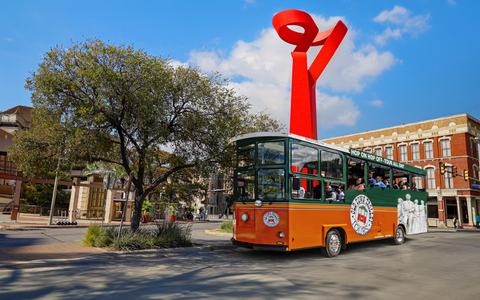
Old Town Trolley Tours has long been a cornerstone of storytelling and hospitality across some of the country’s most iconic destinations. Since its launch, PMax served as a crucial cross-channel engine, allowing the BlackDog Advertising team to showcase Old Town Trolley’s classic sightseeing experiences across YouTube, Maps, Search, and Display. When Google introduced enhanced tools in AI for travel search capabilities, we knew it represented the exact piece needed.
Adopting the newly released AI Max feature this past summer fundamentally shifted campaign performance compared to last summer’s legacy capabilities. By integrating AI Max directly into Old Town Trolley’s search structure, the BlackDog Advertising team transitioned from managing rigid keyword lists to leveraging real-time search intent matching. The results were immediate.
Legacy match types like Google Ads Broad Match often capture non-relevant variations without constant keyword tuning. One of the most impressive outcomes of implementing AI Max was its ability to capture profitable, hidden search queries that fell completely outside standard Google Ads Broad Match syntax. Leveraging AI Max alongside Google Ads Broad Match provided an intelligent layer for Old Town Trolley marketing. Vacationing families and weekend travelers rarely search using textbook phrasing; they ask questions like “how to get around historic downtown.” Standard broad match often requires extensive negative keyword maintenance to prevent unwanted traffic on queries like that, but AI Max evaluated the true intent behind the search.
By accurately recognizing the traveler’s underlying goal, AI Max matched these non-traditional search phrases directly to Old Town Trolley’s relevant landing pages. This dynamic matching capability delivered highly qualified visitors straight to the online booking page. By capturing these long-tail queries before competitors even knew they existed, Old Town Trolley secured direct ticket sales first.
Measuring total year-over-year performance impact for early Summer
To measure the true impact of combining Performance Max with AI Max, we compared the combined Search and PMax metrics for May and June year-over-year (YoY).
The Investment:
We scaled total account spend by 16% YoY across all Search and PMax campaigns, reallocating budget toward AI-driven opportunities.
Traffic Volume:
Generated a 12% increase in clicks specifically from bottom-of-funnel travelers actively searching for sightseeing tours.
Conversion Metrics:
Achieved a massive 101% increase in conversion rate and a 51% growth in total purchase conversion value.
Impressions & CTR:
Total ad impressions actually decreased, while Click-Through Rate (CTR) increased by 435%. This dramatic shift confirmed that ads were being delivered to significantly higher-quality, intent-driven ad placements rather than wasted on low-value views.
Overall Efficiency:
Increased total campaign Return on Ad Spend (ROAS) by 36%, proving that smart automation lowers CPA while driving more profitable direct revenue.
By pairing this powerful tool for search Marketing, AI Max, with the expansive cross-channel reach of Performance Max campaigns, tourism brands can build a Google Ads strategy that works seamlessly to capture demand and lower CPA.
Win more direct bookings through unified search campaigns
At BlackDog Advertising, our mission is to ensure tour and attraction brands stay ahead of the shifting digital trends because navigating this change doesn’t mean choosing between granular control and algorithm-driven scale. As we’ve seen through real-world results with our long-standing partners like Old Town Trolley Tours®, today’s leisure travelers plan trips dynamically, jumping across Search, Maps, and YouTube in real time. By combining the conversational search precision of AI Max with the automated cross-channel reach of Performance Max, tour and attraction operators can bypass high commissions, protect their margins, and build lasting direct relationships with guests. Implementing a dedicated AI for Travel framework is no longer just an advantage to opt in to. Winning the guest booking requires a Google Ads ecosystem that captures intent the moment it happens.
Frequently Asked Questions
Yes, running both side-by-side is considered the ideal setup for modern travel advertising. AI Max acts as your discovery engine on Search to identify new high-intent booking queries. PMax then absorbs those conversion signals to find lookalike travelers and retarget them across YouTube, Maps, and Display, creating a seamless cross-channel booking funnel.
Travelers rarely search using static keywords; they ask complex, conversational questions like “family-friendly morning kayak tours near me.” AI Max uses advanced Search Term Matching and landing page context to match your ads to the underlying intent of a traveler’s query, capturing high-value long-tail searches that keyword lists might have missed.
Online Travel Agencies (OTAs) rely heavily on bidding on broad destination terms to capture bookings and charge commission fees. By combining AI Max search intent matching with PMax visual retargeting across Maps and YouTube, your brand reaches prospective guests before they turn to third-party booking sites, keeping direct revenue and first-party customer data in your pocket.
PMax is particularly beneficial for regional operators with lean marketing spend. Instead of splitting a modest budget across separate Search, Display, and Maps campaigns (where channel minimums dilute impact), PMax acts as a single, flexible engine. Google’s AI automatically routes your spend in real time toward the channel offering the lowest cost-per-booking.
No. Unlike older automated features, AI Max keeps brand guardrails and keyword-level control intact. You maintain full oversight over budget limits, negative keyword lists, brand exclusions, and landing page URLs, ensuring your marketing stays authentic and aligned with your brand standards while the algorithm optimizes delivery.
Because PMax advertises across visual channels like YouTube, Display, and Discover, a strong asset library is key. Operators should provide high-resolution photos of guests enjoying their experience, crisp short-form video clips (portrait and landscape), clear brand logos, and action-oriented ad copy. High-quality visual assets directly improve overall campaign conversion rates.